The Venice Little Black Book
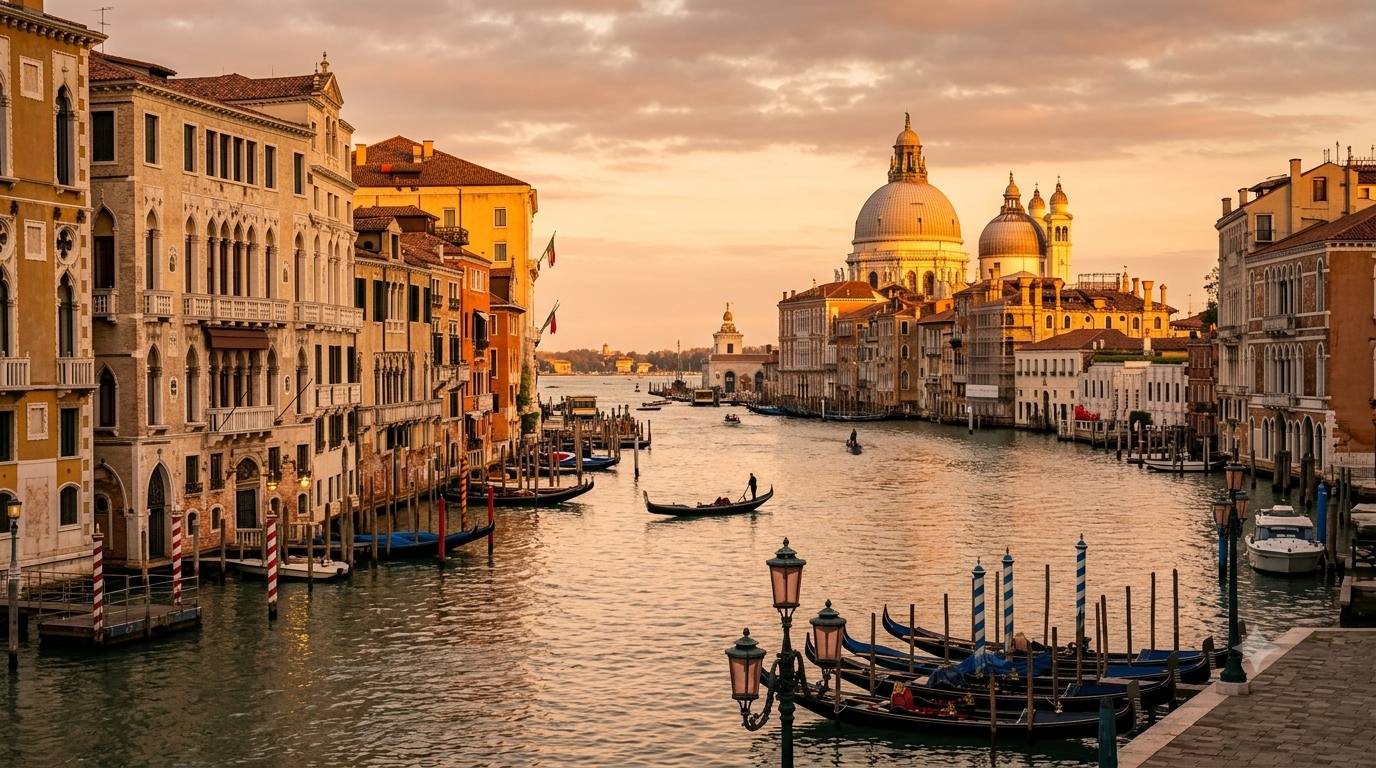
Most people get Venice wrong in the first hour, and the mistake is almost always the same: they arrive by land. They take the bus or the train across the causeway, walk out into a crowd at Piazzale Roma, and spend the rest of the trip fighting the city's grain. Venice was built to be entered from the water, and everything about it — the facades, the front doors, the way a palazzo announces itself — is composed for someone approaching by boat.
Get that one decision right and the city rearranges itself. Our Venice desk books it accordingly: water taxi from the airport, hotel with its own jetty, and a plan that moves against the tide of the day-trippers rather than into it.
What is Venice really like? The great adventures How to spend your days Where to stay Iconic spots, done properly What to eat The luxury insider layer
What is Venice really like for the discerning traveller?
Venice is a hundred-odd islands stitched together with bridges, divided into six sestieri — San Marco, Dorsoduro, San Polo, Santa Croce, Cannaregio and Castello — and wrapped in a lagoon that is itself the reason the city exists. A thousand years of merchants built it as a trading republic facing east, which is why the basilica looks more like Constantinople than Rome and why the palazzo interiors hold Ottoman carpets and Chinese lacquer alongside the Tiepolos.
The practical consequence for a visitor is that Venice has two entirely separate populations occupying the same streets at different hours. Between roughly ten in the morning and five in the afternoon, the corridor from the station to Rialto to San Marco carries an enormous transient crowd. Before nine and after seven, that same corridor empties, and the city that remains — perhaps fifty thousand residents — is quiet, domestic and startlingly beautiful.
Almost every complaint about Venice is really a complaint about being there at the wrong hour. The luxury tier's genuine advantage here is not thread count. It is that staying inside the city lets you use the empty hours, while the day visitor cannot.
Who suits it? Couples, obviously and deservedly. Anyone with an interest in art or architecture will find the density almost unfair — Tintoretto, Titian, Veronese and Bellini are in the buildings they were painted for, not in a national collection somewhere else. Families do well with a boat-centred plan and the islands. What Venice does not suit is a traveller who wants to cover ground quickly; the city is walked, and it is deliberately confusing.
Timing: late April through May, then September into October. August is hot, dense and the least rewarding month. November to January brings acqua alta — the seasonal high tides — though the MOSE barriers now hold back the worst of it, and a misty January Venice with no crowds has its own strong case if you can accept the cold.
Thinking about Venice? Your dedicated specialist will hold the canal-facing suite, the boat and the starred table — free.
Plan this journey with your free conciergeWhat are the great adventures in Venice?
The adventures here are all versions of the same thing: getting onto the water properly, rather than being ferried across it.
The private motoscafo
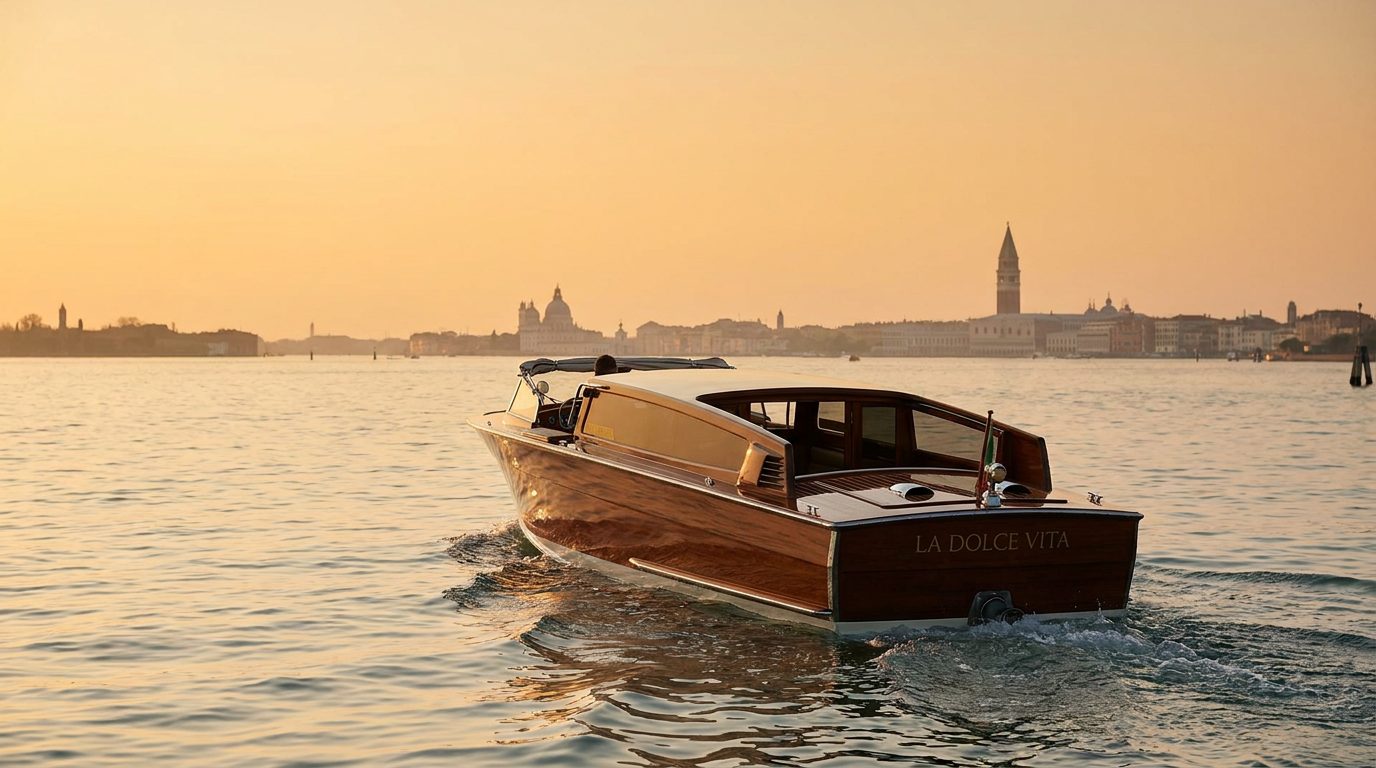
The classic Venetian water taxi is a low, varnished mahogany launch with a small rear deck, and hiring one by the half-day is the single upgrade that changes a Venice trip most. It collects you at your hotel's water door, runs the Grand Canal at whatever hour you choose, and reaches Murano, Burano and Torcello in a fraction of the vaporetto time. Book the airport transfer this way too — arriving at your hotel's own jetty rather than dragging luggage over four bridges sets the entire tone.
Learning to row like a Venetian
Venetians row standing up, facing forward, in a style called voga alla veneta. It looks impossible and is merely difficult. A morning lesson on a batela in the northern canals teaches you why the gondola is shaped so asymmetrically and gives you an hour of the city at water level with no engine noise. It is the most genuinely memorable two hours most of our clients spend here, and it costs a fraction of the things they expected to remember.
The northern lagoon
Beyond Burano the lagoon opens into marsh, sandbank and silence. Torcello Map was settled before Venice itself and is now nearly empty — a cathedral with an eleventh-century Byzantine mosaic of the Last Judgement, a campanile you can climb, and grass. Go late in the afternoon when the day boats have gone, and have lunch at the Locanda Cipriani beforehand.
The Murano furnaces
Glass has been blown on Murano since 1291, when the republic moved the furnaces off the main islands because they kept setting fire to it. The public demonstrations are brief and commercial; a private appointment at one of the serious houses — Venini, Barovier & Toso, Seguso — is something else entirely, an hour watching craftsmen work molten glass at 1,000°C with tools that have not changed design in six centuries. Arrange it in advance; the good furnaces do not take walk-ins.
How should you spend your days in Venice?
The rhythm that works inverts the tourist day. Be out early, retreat at midday, and use the evening hard.
Day one — the centre, correctly timed. Piazza San Marco at seven in the morning is nearly empty and worth setting an alarm for. Take the basilica on a pre-opening or early-entry basis, then the Doge's Palace on the Secret Itineraries route before the general crowd arrives. Retreat for lunch and a long afternoon at the hotel. In the evening, walk the Zattere in Dorsoduro as the light goes, and eat late.
Day two — art, then water. The Gallerie dell'Accademia and the Peggy Guggenheim Collection sit within ten minutes of each other in Dorsoduro; two hours in each is honest. In the afternoon take the boat out to Murano and Torcello. Return through the lagoon at dusk, which is the photograph everyone actually wants.
Day three — the quiet sestieri. Cannaregio in the morning — the Jewish Ghetto, the oldest in the world, and the Madonna dell'Orto church where Tintoretto is buried among his own paintings. Then Castello, which is where Venetians actually live and where the Biennale gardens are. A bacaro crawl in the evening rather than a restaurant booking.
With longer, add the Palladian churches on Giudecca and San Giorgio Maggiore, whose campanile gives the best view of Venice precisely because you are standing outside it looking back.
We sequence the hours so you see San Marco empty and skip the queue entirely.
Plan this journey with your free conciergeWhere should you stay in Venice?
Location in Venice means one thing above all others: does the hotel have its own water entrance? If it does, your boat delivers you to the door and the city works. If it does not, every arrival and departure involves luggage and bridges.
| Hotel | Where | Tier | Best for |
|---|---|---|---|
| Nolinski Venezia | San Marco, by La Fenice | Refined | Contemporary design, opera-night location |
| Ca' Sagredo | Cannaregio, Grand Canal | Refined | A genuine 15th-century palazzo at fair value |
| The St. Regis Venice | San Marco, Grand Canal | Luxury | Butler service and a garden terrace on the water |
| The Gritti Palace | San Marco, Grand Canal | Luxury | The classic canal-front terrace facing the Salute |
| Belmond Hotel Cipriani | Giudecca | Ultra | Space, gardens and the city's only large pool |
| Aman Venice | San Polo, Grand Canal | Ultra | Tiepolo ceilings and near-total privacy |
Nolinski Venezia — Refined
A recent arrival a minute from Teatro La Fenice, and the most convincingly modern hotel in a city that mostly does not do modern. Strong bar, strong bathrooms, and a location that makes a night at the opera effortless. No water door, which is the trade-off for the price and the position.
Ca' Sagredo — Refined
An actual palazzo — a monumental staircase, a frescoed ballroom, and a Grand Canal terrace — at a price the Grand Canal does not usually permit. Rooms vary considerably; the canal-facing ones are the reason to come and are worth insisting on. Cannaregio's position also puts you closer to where Venetians eat.
The St. Regis Venice — Luxury
A run of five connected palazzi rebuilt around a rare thing in Venice: a garden that opens directly onto the Grand Canal. The butler service is the real St. Regis article rather than a badge, and the terrace bar is one of the better places in the city to watch the water at aperitivo hour.
The Gritti Palace — Luxury
The Gritti's terrace, looking straight across at Santa Maria della Salute, is the most photographed hotel view in Venice and deserves the reputation. Inside it is antique-heavy and unashamedly grand — Fortuny fabrics, Murano glass, Rubelli silk. It suits travellers who want Venice to feel like Venice rather than like a design hotel that happens to be here.
Belmond Hotel Cipriani — Ultra
On Giudecca, three minutes by the hotel's own launch from San Marco, and the answer for anyone who wants Venice without the compression. It has gardens, a vineyard, tennis, and the Olympic-size saltwater pool that no other Venice hotel can offer. The shuttle runs constantly, so the island position costs you nothing except the willingness to take a boat — which you should be doing anyway.
Aman Venice — Ultra
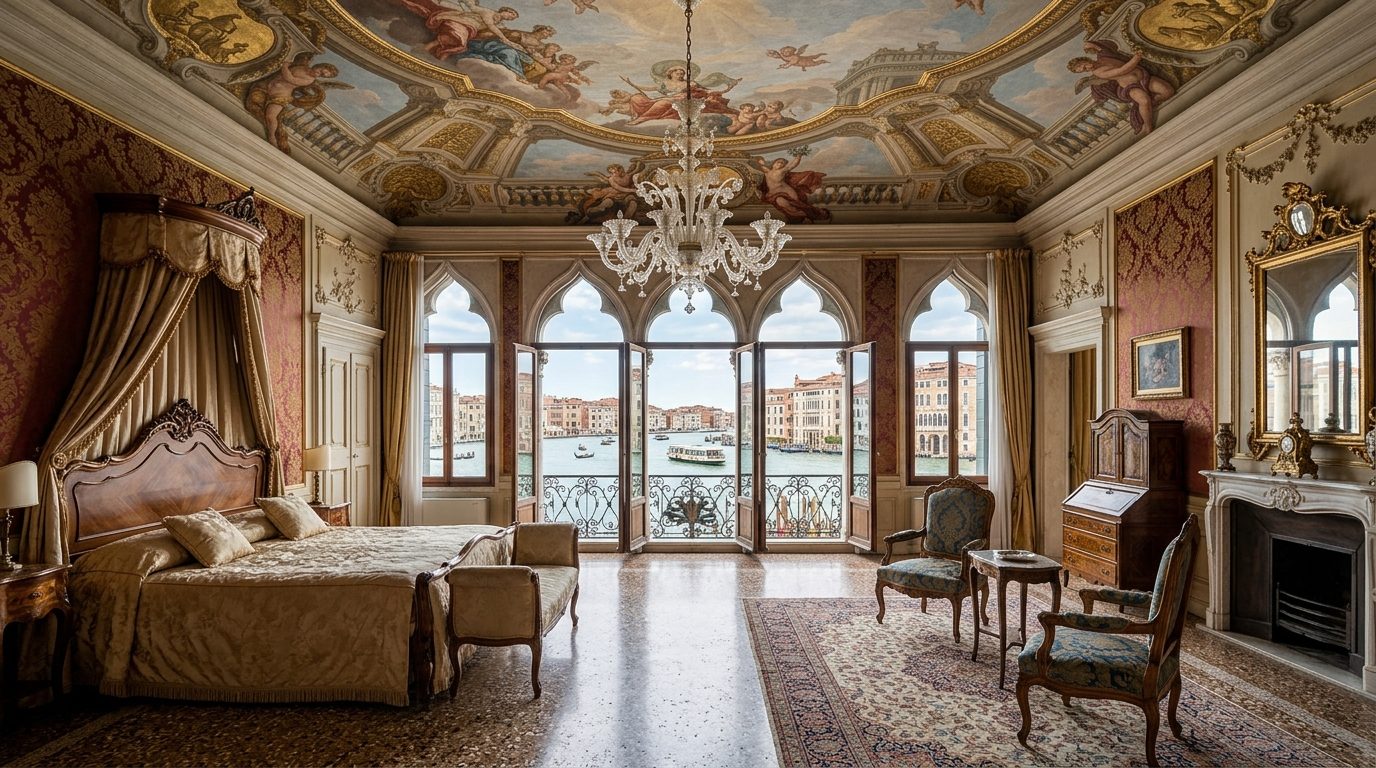
The Palazzo Papadopoli on the Grand Canal, with two intact Tiepolo ceilings, a pair of private gardens and only a couple of dozen rooms. It is the quietest grand hotel in the city and the most architecturally serious — you are staying inside a listed sixteenth-century building whose piano nobile has been restored rather than reinterpreted. Book the Alcova Tiepolo Suite if the trip warrants it.
We hold the canal-facing rooms, not the courtyard ones — and we tell you which is which.
Plan this journey with your free conciergeWhich iconic spots deserve your time — and how do insiders see them?
St Mark's Basilica
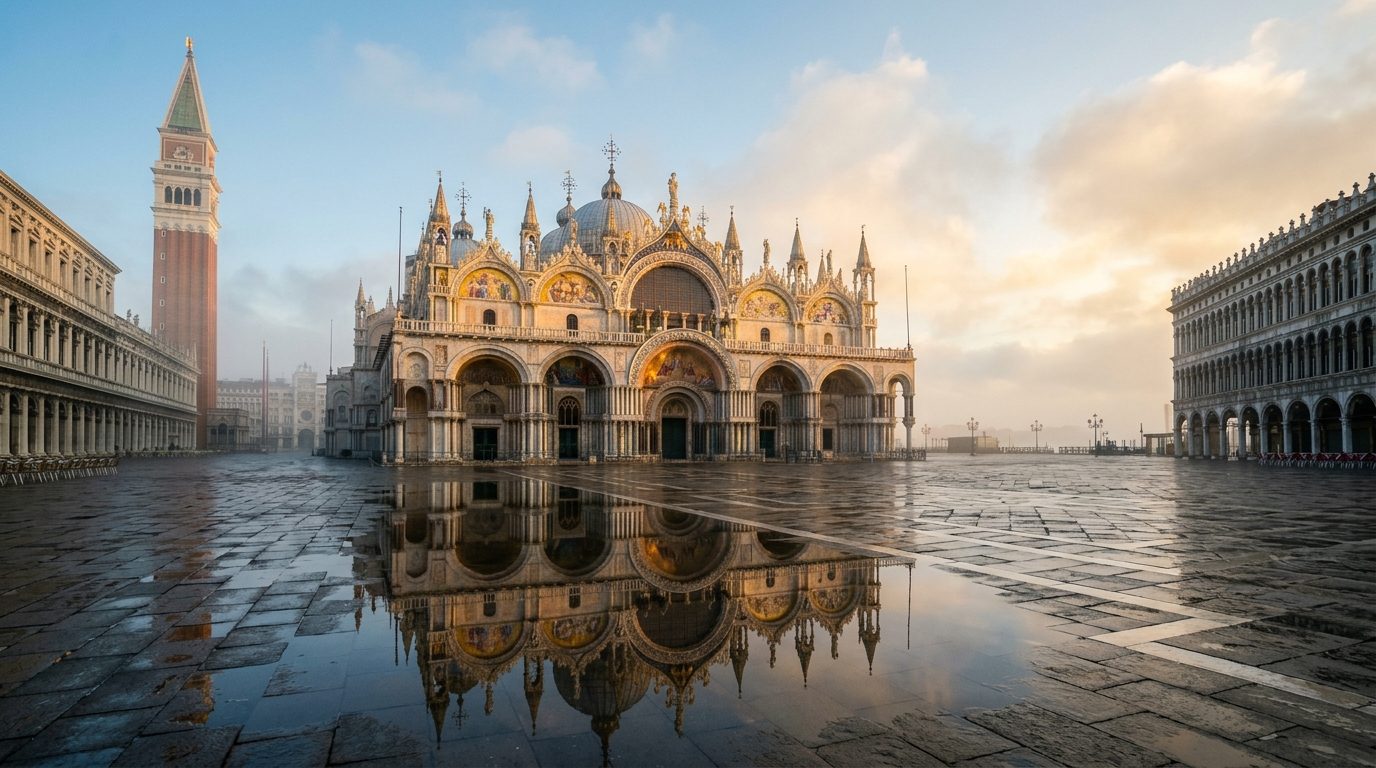
Eight thousand square metres of gold mosaic, built to house a body stolen from Alexandria in 828 and decorated with marble looted from Constantinople in 1204. Venice's whole self-image is in this one building. Map Go at opening or on a pre-opening access slot, and pay the small extra for the Pala d'Oro and the loggia — the bronze horses up there are the ones the Venetians took from the hippodrome, and the balcony gives you the piazza from above.
The Doge's Palace and the Secret Itineraries
The standard route through the palace is grand and busy. The Itinerari Segreti tour takes a small group through the working parts instead — the chancellery, the interrogation room, the lead-roofed cells under the eaves that Casanova escaped from. It is a better hour by a wide margin and it must be booked ahead. Map
Scuola Grande di San Rocco
Tintoretto spent twenty-three years covering this building's walls and ceilings, and the result is the single most overwhelming room in Venice — a Crucifixion that occupies an entire wall. It is rarely crowded because most visitors have never heard of it. Map Take one of the mirrors they lend you at the door so you can look at the ceilings without ruining your neck.
Peggy Guggenheim Collection
An unfinished palazzo on the Grand Canal where the heiress lived for thirty years, now holding Pollock, Picasso, Ernst, Magritte and Brancusi in domestic-sized rooms. Map The sculpture garden and canal terrace make it the most pleasant museum visit in the city. She is buried in the garden beside her dogs.
Punta della Dogana and Palazzo Grassi
The old customs house at the tip of Dorsoduro, converted by Tadao Ando into a contemporary art space for the Pinault Collection, with its sister venue at Palazzo Grassi. Even when a show does not land, the Ando interior against the fifteenth-century brick is worth the ticket, and the point of the Dogana is one of the great places to stand in Europe.
Rialto, and how to survive it
The bridge itself is a five-minute experience and a crush. The market beside it — fish on one side, produce on the other — is the real thing and closes by early afternoon, so it is a morning errand. Go at seven-thirty, watch the restaurant buyers work, and then have your first ombra of the day in one of the bacari behind it while the bridge fills up without you.
What should you eat in Venice?
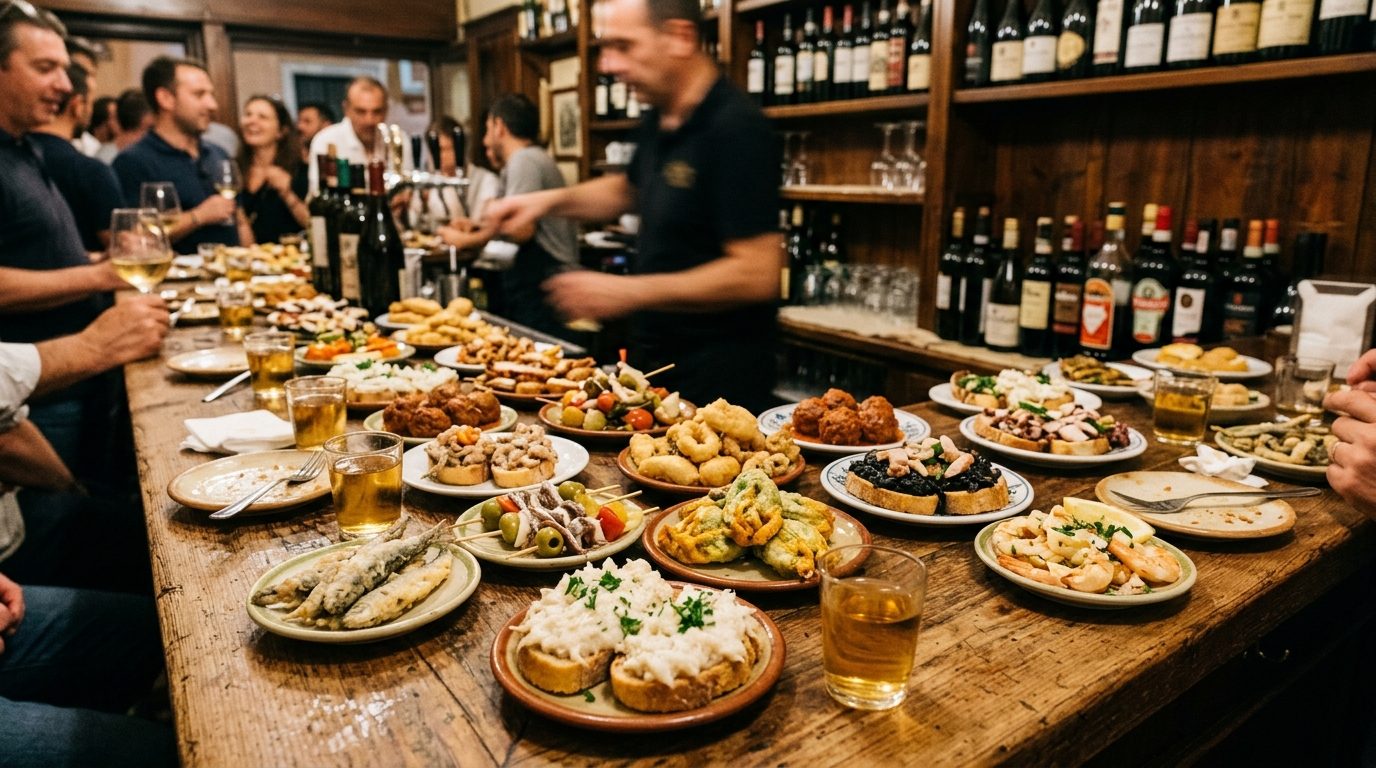
Venice has an unfair reputation for bad food, earned entirely in the tourist corridor and entirely undeserved once you step out of it. The city's real cuisine is lagoon cuisine — fish, rice, bitter greens from the island market gardens — and its social form is the bacaro, not the restaurant.
The starred tables
Glam by Enrico Bartolini, in the garden of Palazzo Venart, holds two Michelin stars and is the most ambitious cooking in the city — lagoon ingredients handled with real technical seriousness. Book four to six weeks ahead. Quadri, the Alajmo family's restaurant directly on Piazza San Marco, holds a star and is the only genuinely good reason to eat on the square. Oro at the Cipriani holds a star and has the advantage of the lagoon view across to San Marco. Local, in Castello, holds a star with a more contemporary Venetian register and is easier to get into.
The lagoon's own plates
Learn four dishes and you will eat well anywhere here. Sarde in saor — sardines cured with onions, pine nuts and raisins, a sailor's preservation trick from the fourteenth century. Risotto di gò, made with the small lagoon goby, the benchmark of a serious kitchen. Bigoli in salsa, thick wholemeal pasta with onion and anchovy. And fegato alla veneziana, calf's liver with sweet onions, which is better than it sounds by a considerable margin.
The bacaro protocol
A bacaro is a small wine bar with a counter of cicchetti — crostini with baccalà mantecato, fried sardines, half a boiled egg with an anchovy. You order an ombra, a small glass of wine, eat two or three things standing up, and move to the next one. The strip along Fondamenta della Misericordia in Cannaregio is the best run of them; the old bacari behind the Rialto market — All'Arco and Cantina Do Mori among them — are the historic ones. Do this instead of one long dinner at least once.
Harry's Bar
The Bellini was invented here and so was carpaccio, both named after Venetian painters whose colours the drink and the dish were thought to resemble. It is expensive, small, and utterly unbothered about being fashionable. Go once, sit at the bar, have the Bellini, and understand that you are paying for 1931 rather than for the peach juice.
Bartolini's two stars book out six weeks ahead. We hold the table before you land.
Plan this journey with your free conciergeWhere is the luxury insider layer of Venice?
The gondola, done properly
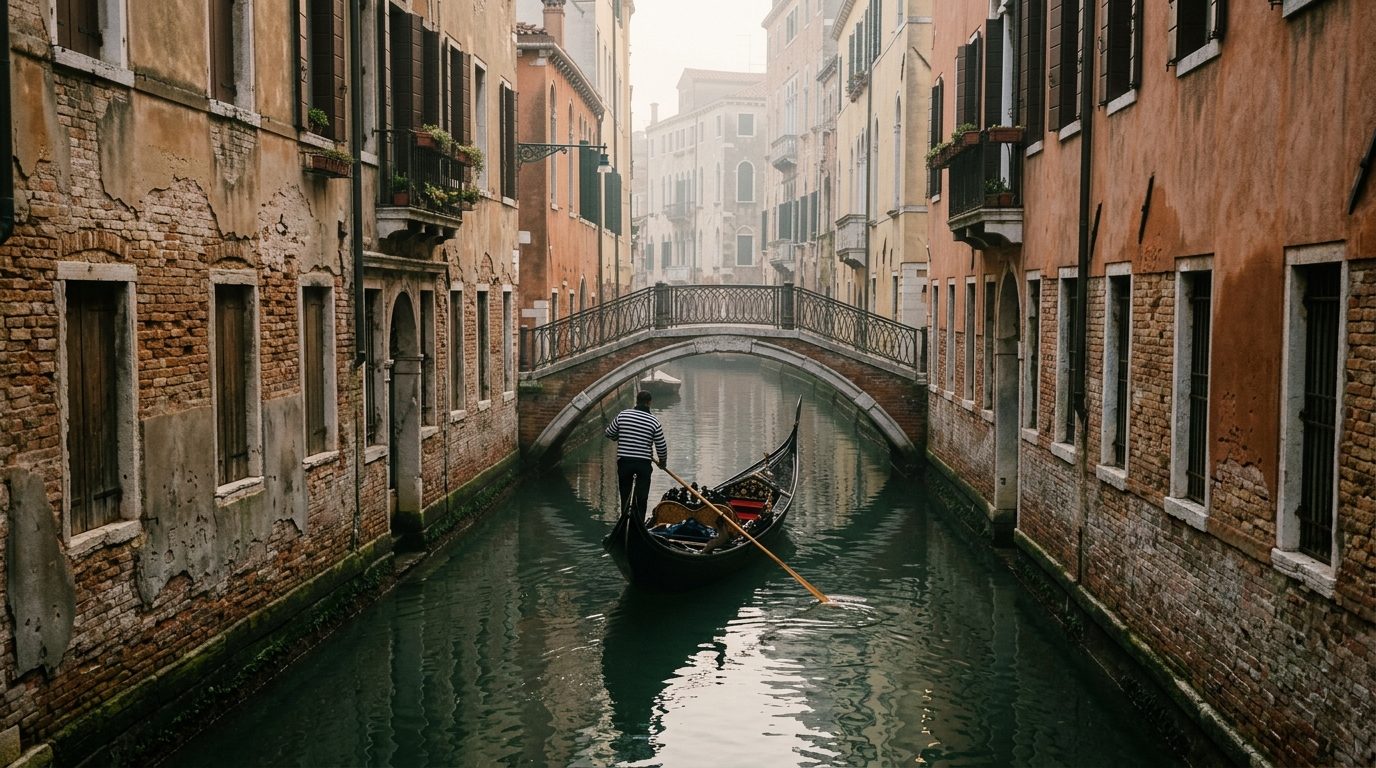
A gondola on the Grand Canal at two in the afternoon is a queue with a boat attached. A gondola at seven in the morning through the back canals of Dorsoduro or Cannaregio is one of the quietest, strangest half-hours available anywhere in Europe: no engine, no crowd, water slapping brick, and the city at the level it was designed to be seen from. Agree the route with the gondolier in advance and ask specifically for the small canals. The boats themselves are worth understanding too — each is asymmetric by about 24 centimetres so that a single oar on one side drives it straight. The Squero di San Trovaso, one of the last yards still building them, can be seen across the canal from the Zattere.
Textiles, which is what Venice actually sells
Glass gets the attention; fabric is the deeper craft. Fortuny still prints on Giudecca using the methods Mariano Fortuny developed a century ago and will not explain them to anyone. Bevilacqua has been weaving silk velvet on eighteenth-century hand looms since 1875 — a skilled weaver produces a few dozen centimetres a day. Both can be visited by appointment, and both will ship. This is the souvenir worth having.
Private palazzo access
A significant amount of Venice is behind doors that do not open to the public — private collections, family palazzi, deconsecrated churches, the odd working artist's studio. Access to these is entirely relationship-based and is the clearest case in the city where a concierge desk earns its position: an evening drink in a private piano nobile on the Grand Canal is not a thing you can book.
Timing around the calendar
Venice's event calendar swings both prices and atmosphere hard. The Biennale runs from spring to autumn and turns the Arsenale and Giardini into the most interesting art or architecture exhibition on earth, depending on the year. The Film Festival takes over the Lido in late summer. Carnevale fills February. The Festa del Redentore in July puts a pontoon bridge across the Giudecca canal and a serious fireworks display over the water — the correct way to see it is from a boat, with dinner on board, which needs arranging months out. Any of these is a reason to go; none of them is a week to arrive unprepared.
The access fee, and who pays it
Venice now charges day visitors an access fee on controlled dates — a response to the sheer volume arriving from cruise ships and the mainland. Overnight guests staying in a Venice hotel are exempt, but your hotel registers you and issues a code you should be able to produce. It is worth knowing simply because it is the one piece of Venetian bureaucracy that rewards staying in the city rather than visiting it.
Venice rewards the traveller who arrives by water and moves against the crowd. We build both into the plan.
Plan my Venice journey