The Petra Little Black Book: The Rose City, Done Properly
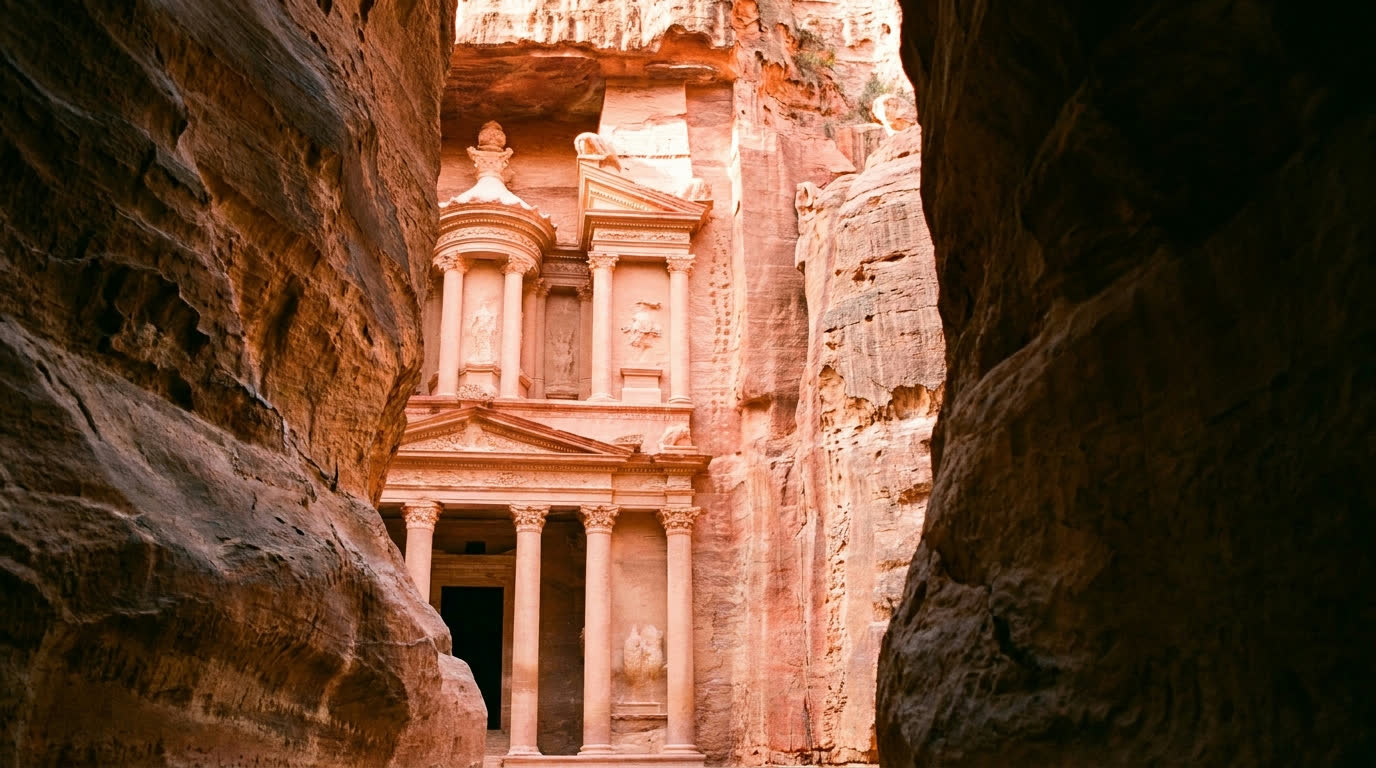
Petra earns its wonder-of-the-world billing in a single moment: the last bend of the Siq, when a slice of carved rose facade appears in the canyon crack ahead. Two thousand years ago this was the Nabataean capital, rich on frankincense caravans; today it is Jordan's crown and, handled lazily, a hot four-hour queue. Handled properly — early gates, high trails, a Wadi Rum night attached — it is the best archaeological journey within four hours of Dubai. Our Petra concierge page has the short version.
Two facts frame everything. The site is vast — 264 square kilometres, of which day-trippers see perhaps four. And the light is the event: rose stone goes crimson at dawn and gold at dusk, grey at noon. Schedule for stone, not for breakfast.
What is Petra really like? The big adventures What to do day by day Where to stay The iconic spots What to eat The luxury insider layer
What is Petra really like?
Petra is a carved city, not a building — an entire Nabataean metropolis of tombs, temples, theatres and water channels cut into rose sandstone canyons, lost to the West for six centuries until a Swiss explorer talked his way in disguised as a pilgrim in 1812. It suits travellers who will walk: seeing it properly means 10–20 kilometres a day on sand and ancient steps, and every metre repays.
The gateway town, Wadi Musa, is a functional strip of hotels and grills — nobody's destination, everybody's base. The site itself still holds its Bedouin community, the Bdoul, who ran shops and stables inside the caves until the 1980s and now run the tea stalls and camel commerce along the trails. Take the tea when offered. Refuse the "shortcut" donkey rides up the Monastery steps; the animals' welfare is contested and your legs are the point.
Season honestly: spring and autumn are ideal at 20–28°C. Summer hits 35°C+ with zero shade on the main valley floor — dawn and late-afternoon site sessions only, siesta between. Winter is cold, occasionally wet (flash-flood closures happen), and gloriously empty; January visitors often get the Treasury plaza to themselves by 4pm.
Every address in this guide can be reserved, sequenced and chauffeured for you — free, by your dedicated Dubai-based specialist.
Plan this journey with your free conciergeWhat are the big adventures at Petra?
Three: the back-door trek from Little Petra, the high trails above the Treasury, and Wadi Rum — the desert that pairs with Petra the way Wadi Musa pairs with dinner. Each converts the postcard into an expedition.
The back door from Little Petra
The connoisseur's entrance: drive to Little Petra (Siq al-Barid), the Nabataeans' caravan suburb Map, then trek two to three hours across high desert to arrive at the Monastery from above — meeting Petra's biggest monument first, with the crowds far below and the site unrolling downhill for the rest of the day. This is the final leg of the celebrated Dana-to-Petra trek, routinely listed among the world's great walks; committed hikers can take four days through Dana's canyons to do it in full. We arrange licensed guides, permits and luggage transfer for both versions.
The high trails
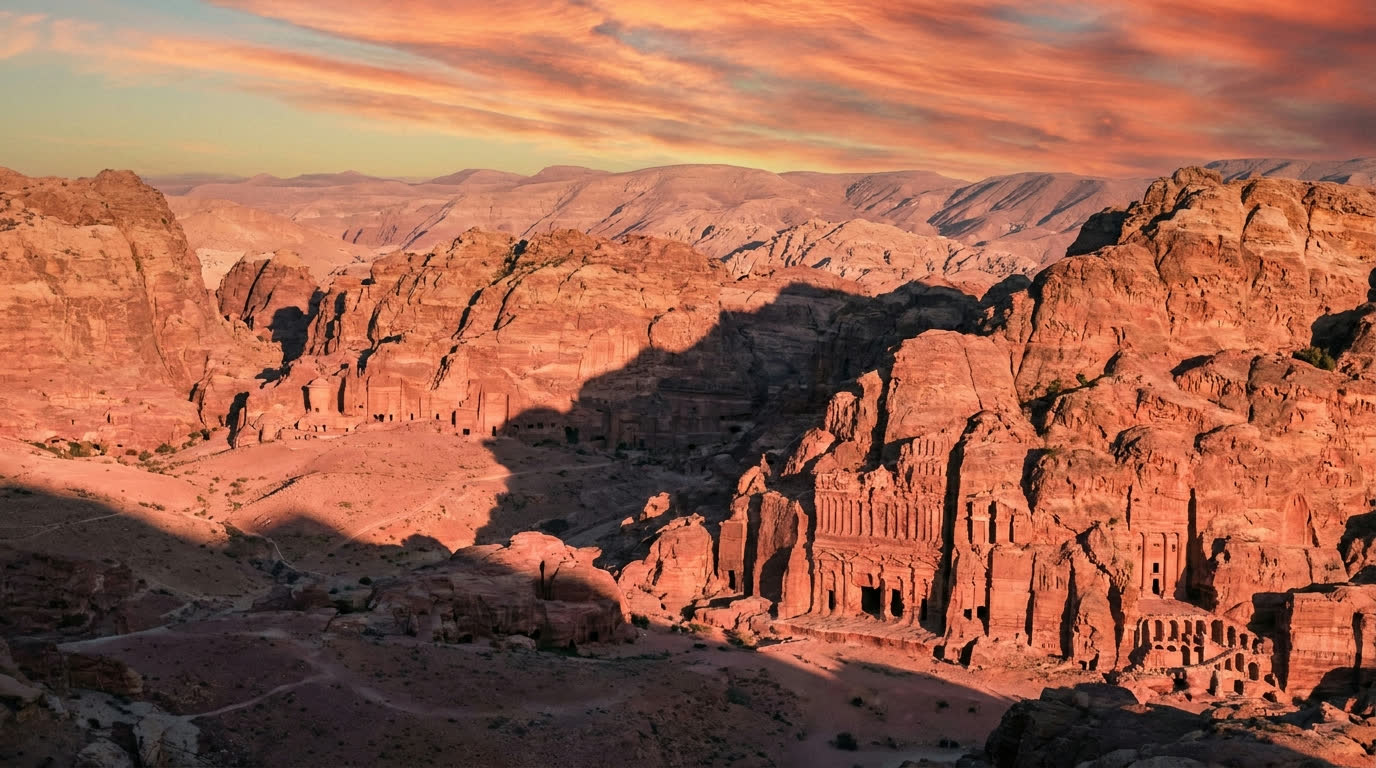
The Al-Khubtha trail climbs behind the Royal Tombs to the ledge photographed a million times: the Treasury from directly above, framed by the canyon Map. Ninety minutes up, tea shack at the top, vertigo optional but likely. The High Place of Sacrifice route is shorter and crosses an intact Nabataean altar platform with the whole valley below.
Wadi Rum
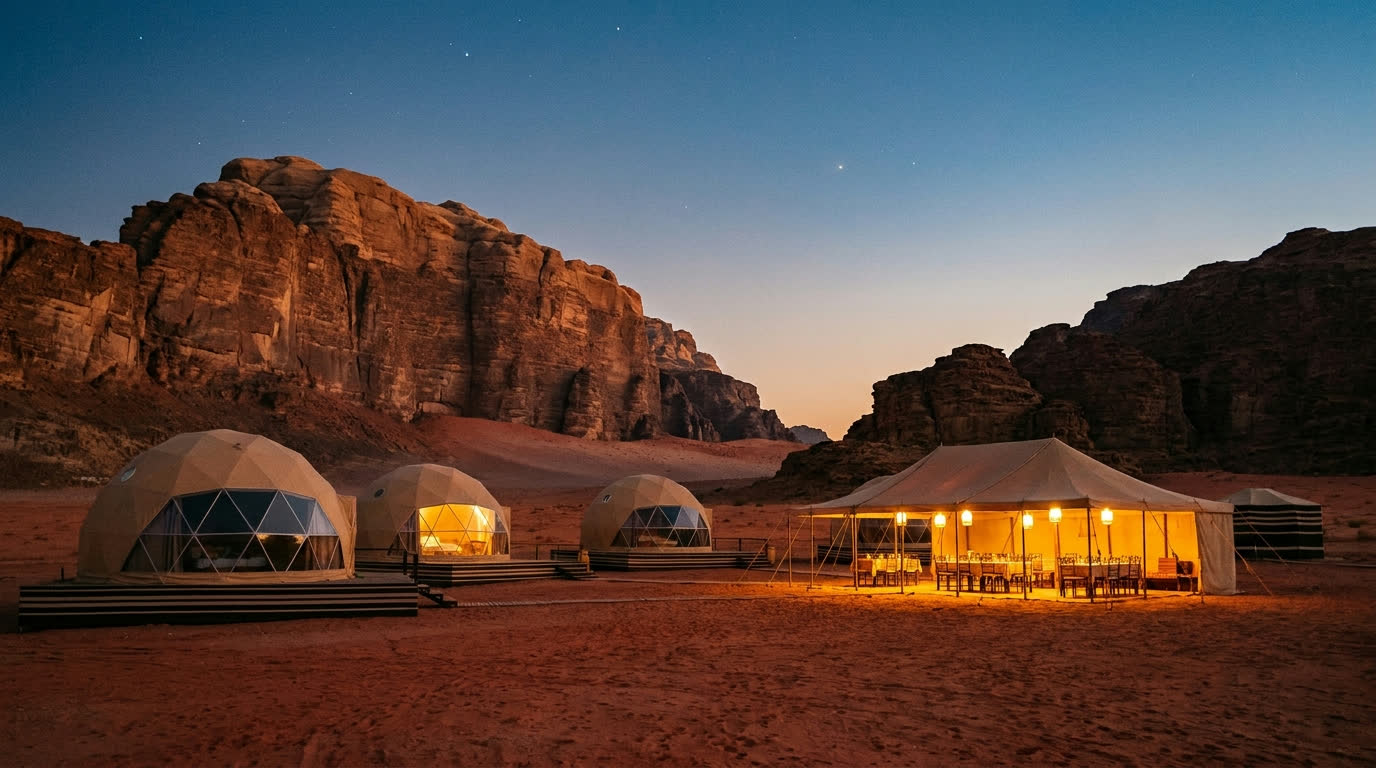
Ninety minutes south, the desert of Lawrence and every recent Mars film: red dunes, thousand-metre sandstone walls, silence you can hear Map. The programme writes itself — 4x4 through the protected area with a Zalabieh Bedouin driver, sunset from a dune ridge, dinner cooked in a zarb sand oven, and dawn by hot-air balloon if the winds agree. Do not day-trip it; the night sky is half the show.
What should you do day by day at Petra?
The correct core is four days: two in the site, one in Wadi Rum, one in transit softened by stops. Rushing Petra into a single day is the region's most common and most regretted itinerary decision.
Day one: gates at 6am. Siq and Treasury in morning light and near-solitude, then the Street of Facades, the 7,000-seat theatre and the Royal Tombs before the heat. Long lunch and siesta at the hotel. Return at 3:30pm for the Colonnaded Street and Qasr al-Bint temple, exiting in gold light. If it is Monday, Wednesday or Thursday: Petra by Night at 8:30.
Day two: the Monastery, by back door trek or by the 850-step climb from the basin (morning shade, going up). Al-Khubtha viewpoint in the afternoon for the Treasury from above. Day three: Wadi Rum. Day four: north with stops — Shobak crusader castle, Dana's viewpoint — or west to a Dead Sea resort afternoon, floating off the leg miles.
With children: Petra works brilliantly from about age eight — treasure-hunt energy, caves, camels — with two riders: distances need honest management (the site's horse-carts now shuttle the Siq stretch), and the high trails are teens-and-up. The Petra Museum by the gate, free and excellent, makes the pre-visit primer.
Where should you stay at Petra?
Wadi Musa hotels trade views against gate distance; for dawn starts, distance wins. The luxury night belongs to Wadi Rum's camps. We book the pairing as one arc: two nights at the gate, one under canvas.
| Property | Tier | Indicative from | Best for |
|---|---|---|---|
| Mövenpick Resort Petra | Luxury | USD 250/night | Directly opposite the gate; 6am starts on foot |
| Petra Marriott | Luxury | USD 180/night | Great Rift valley views from above Wadi Musa |
| Petra Guest House | Refined | USD 130/night | Beside the gate; the Cave Bar in a Nabataean tomb |
| Memories Aicha Luxury Camp, Wadi Rum | Luxury | USD 300/night | Full-service desert camp, panoramic suites |
| Wadi Rum bubble domes | Luxury | USD 350/night | Transparent star-gazing domes with hotel comforts |
Mövenpick Resort Petra Map
Thirty seconds from the visitor centre — the entire strategic value in one sentence. Oriental-style atrium, a decent pool for the siesta hours, and breakfast from 6am so the dawn plan survives contact with reality. Ask for a room away from the street side; Wadi Musa wakes early and loudly.
Memories Aicha Luxury Camp Map
The polished end of Rum's camp spectrum: panoramic suites with full glass walls facing the massif, proper bathrooms, Bedouin dinner service and heaters for the sharp desert nights (pack a layer even in May — the temperature falls off a cliff at sunset). The martian-view suites book out weeks ahead in spring; hold them early.
One honest note on Petra-area "ultra" luxury: it does not yet exist at Amangiri grade, and anyone selling it as such is decorating. What Jordan offers instead — gate-adjacent comfort plus a world-class desert night — is its own category, and priced kindly for what it delivers.
Every address in this guide can be reserved, sequenced and chauffeured for you — free, by your dedicated Dubai-based specialist.
Plan this journey with your free conciergeWhich iconic spots deserve your time?
Five, in visit order: the Siq, the Treasury, the Royal Tombs, the Monastery and Petra by Night. The insider angle at each is timing plus altitude — the crowds live at noon on the valley floor, and almost nowhere else.
The Siq Map
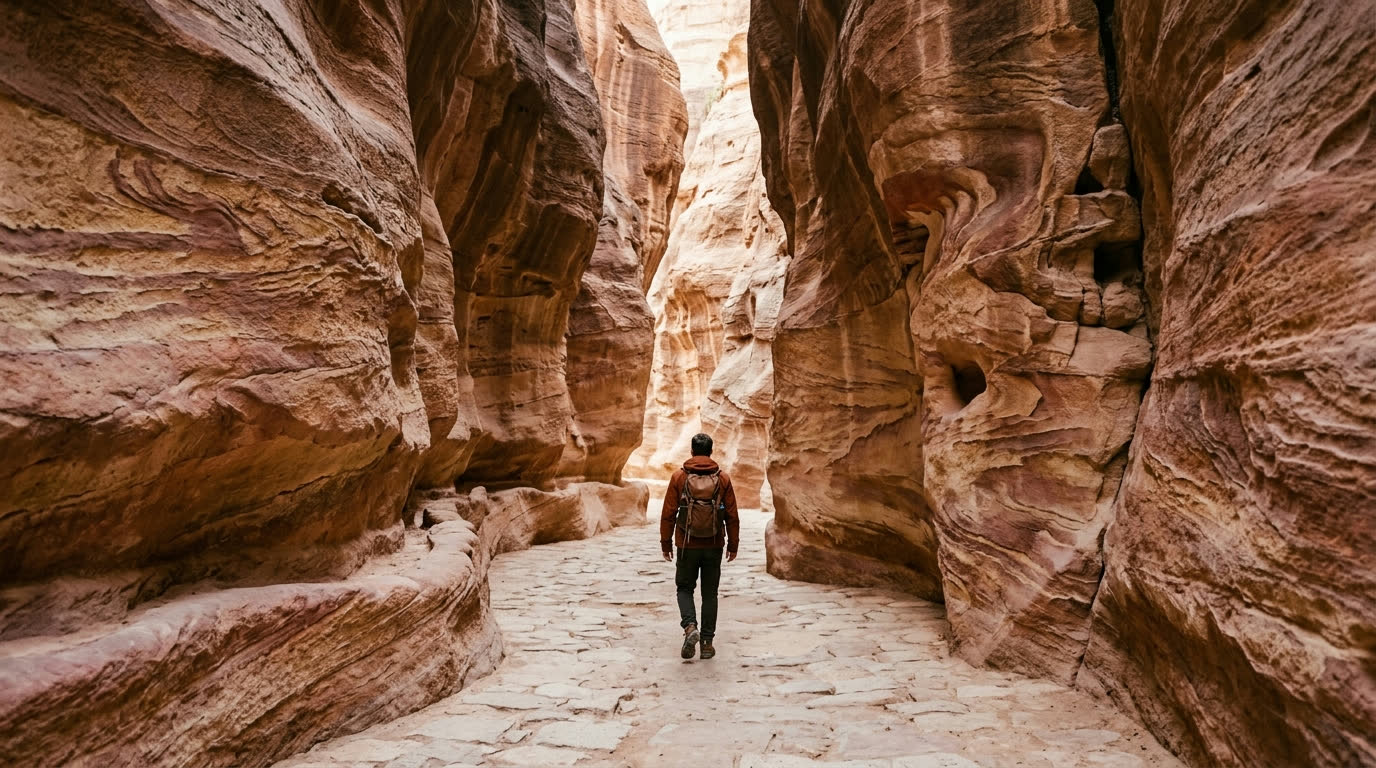
A 1.2-kilometre fault crack, walls to eighty metres, floor still carrying stretches of Nabataean paving and the water channels that made a desert capital possible. Walk it slowly and early; at 6:15am your footsteps echo. Look for the worn camel-caravan relief two-thirds along on the left — most groups march straight past it.
The Treasury (Al-Khazneh) Map
Forty metres of carved Hellenistic-Nabataean facade, probably a royal tomb, named for a legend that the urn on top held pharaoh's gold — the bullet scars from hopeful marksmen are still visible. Direct sun hits the facade mid-morning (roughly 9–11am depending on season); photographers get glow-light at opening and again as reflected light after 4pm. The plaza empties dramatically in the last hour before closing.
The Monastery (Ad-Deir) Map
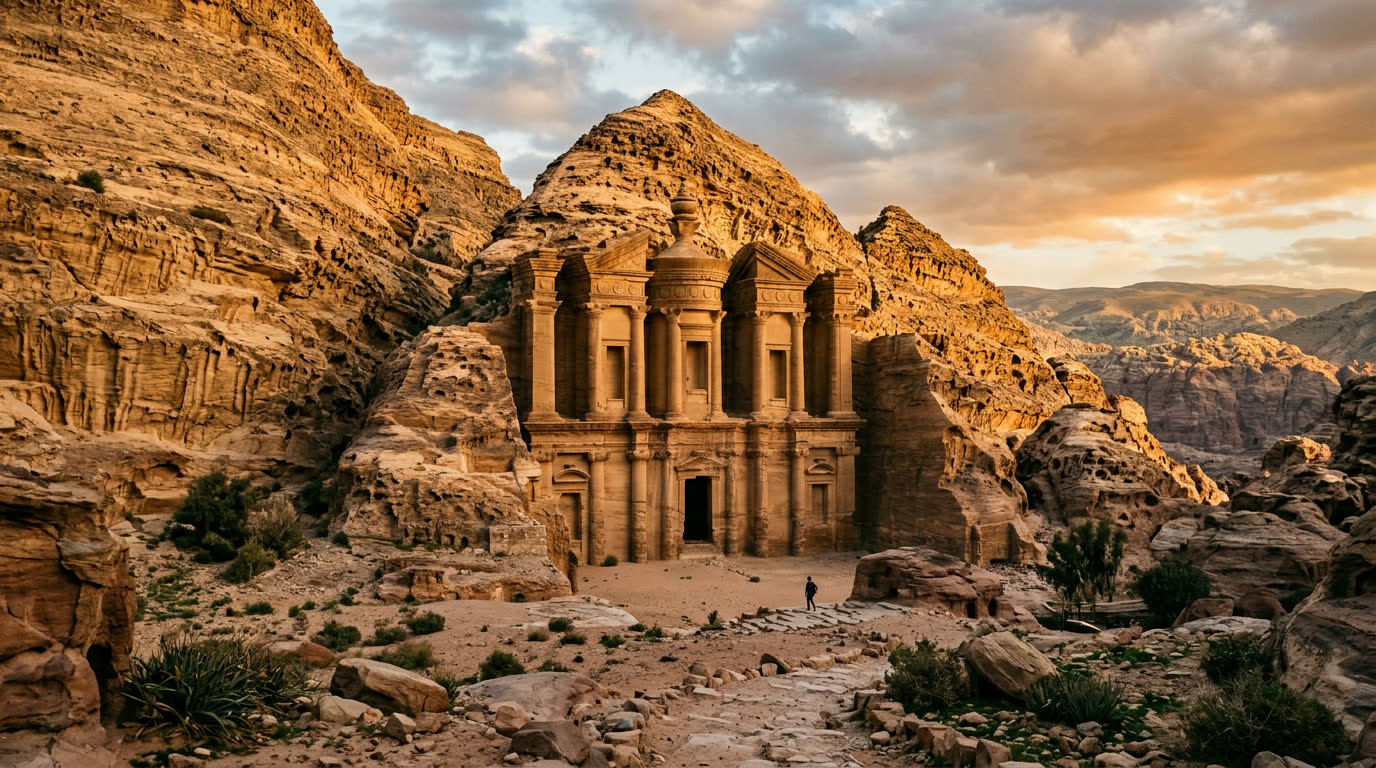
Bigger than the Treasury and better lit: the facade faces west, so late afternoon turns it to gold. Via the main route it is 850 rock-cut steps from the basin — 45–60 minutes, tea stalls en route — or arrive from above by the back-door trek. The "Best View in the World" cafe on the ridge opposite oversells by only a little.
Petra by Night Map
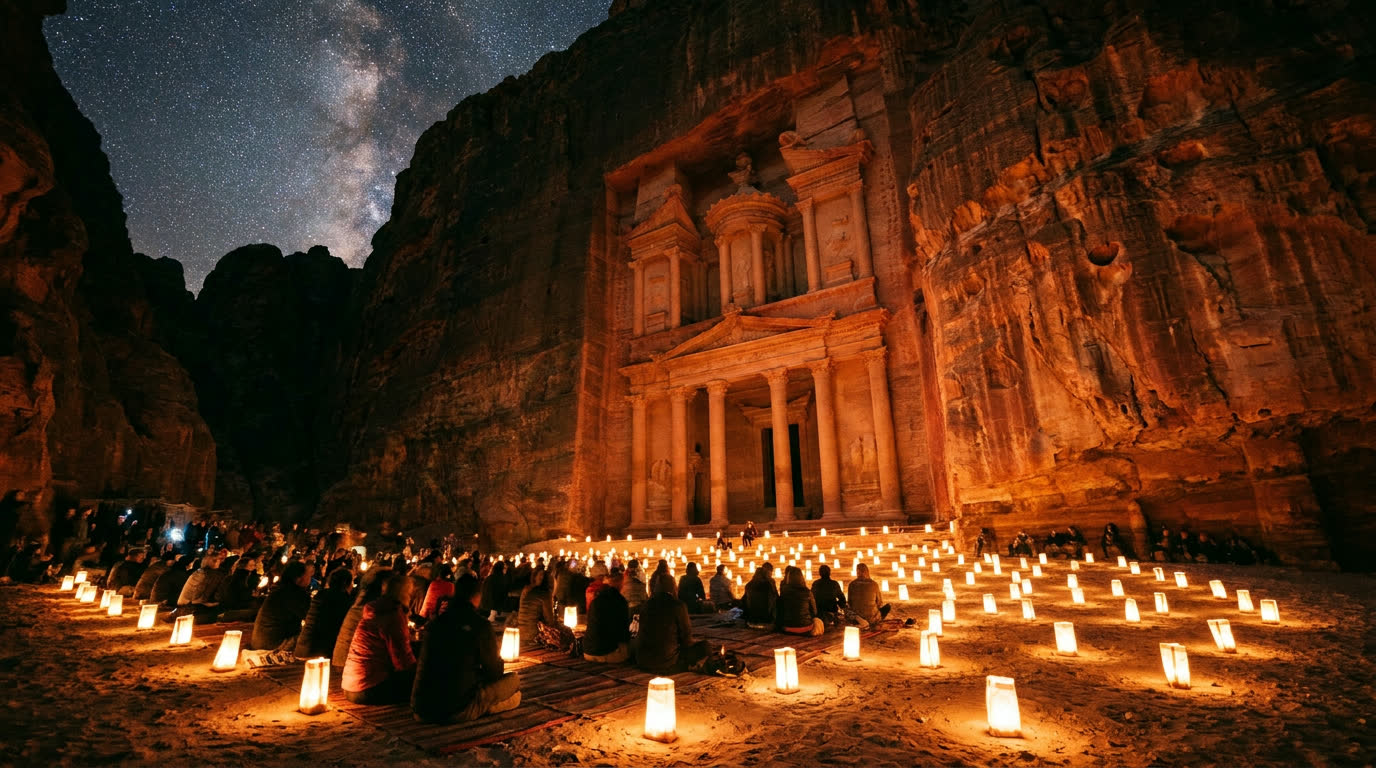
Monday, Wednesday and Thursday at 8:30pm: the Siq and Treasury plaza lit by roughly 1,500 candles, Bedouin flute and storytelling under the stars. Go with calibrated expectations — it is quiet magic, not son-et-lumière — and sit at the plaza's rear edge where the whole candle field spreads before the facade. Cold even in summer; bring the layer.
What should you eat around Petra?
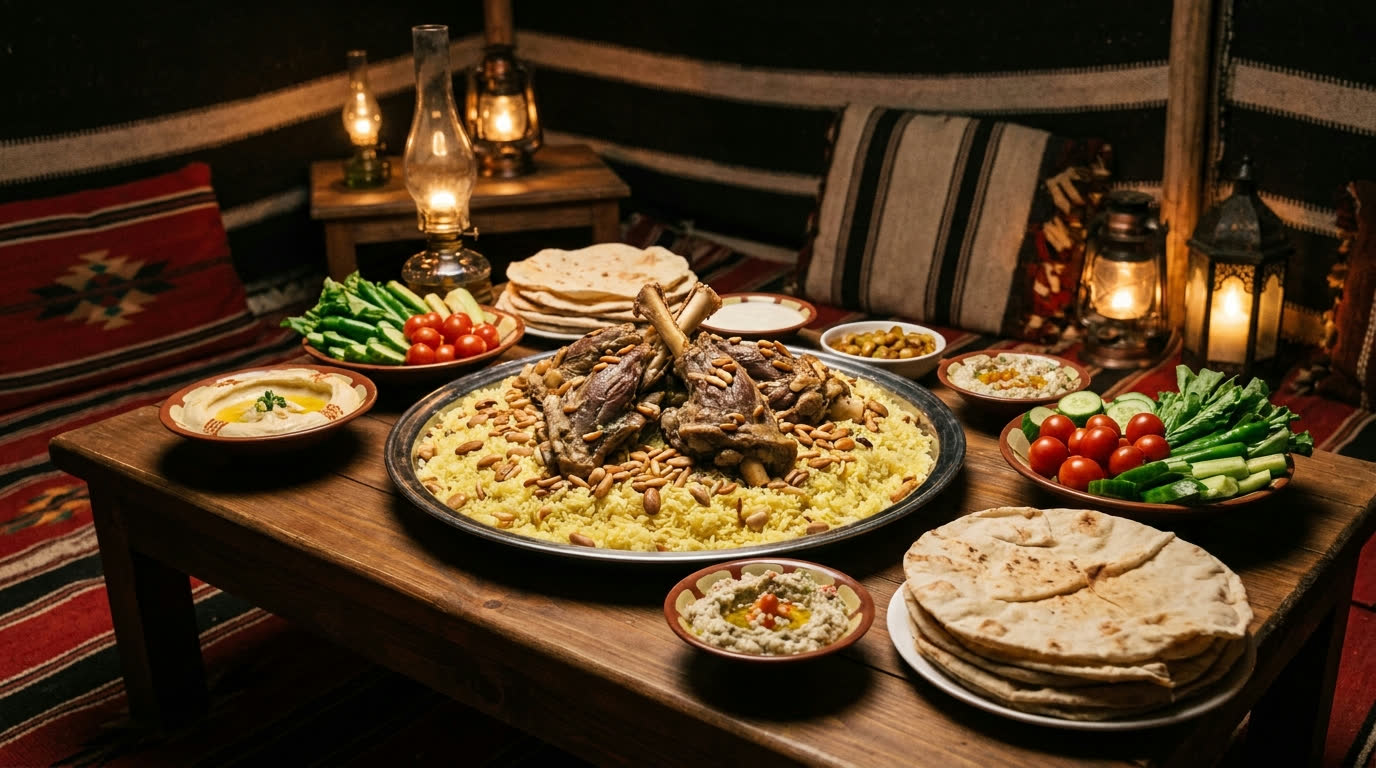
Jordanian cooking is generous, slow and built for sharing: mansaf — lamb over rice under a sauce of fermented dried yoghurt called jameed — is the national dish and the thing to order once, properly. Around it, a strong mezze culture and the Bedouin zarb: meat and vegetables buried over coals in a sand pit and exhumed at dinner like archaeology you can eat.
In Wadi Musa: Al Qantarah does the full traditional spread in a stone house near the gate — their mansaf and maqluba are the town's benchmark Map. Petra Kitchen runs evening cooking classes where you make the mezze you then eat, a genuinely good first-night move Map. Inside the site, The Basin restaurant provides the civilised lunch stop under trees near Qasr al-Bint. And the Cave Bar beside the gate pours drinks inside a 2,000-year-old Nabataean tomb — billed as the oldest bar on Earth, and for once the marketing is arguably underclaiming Map.
In Rum, dinner is the zarb at camp, eaten under more stars than seems administratively possible. Our advice: request the pit-opening moment — watching dinner rise steaming out of the sand is the desert's best theatre.
Where is the luxury insider layer at Petra?
Petra's insider layer is not velvet rooms — it is access, timing and the right people: private archaeologist guides, closed-corner trails, desert camps held for you in high season. The raw materials are cheap here; the orchestration is the luxury.
Private guiding and access
The difference between a walk and a revelation is a licensed archaeologist-guide who can read the water channels, the god-blocks and the tomb hierarchies as you pass them. We book the handful worth having — for the site, the back-door trek and Little Petra — plus horse-cart or mobility arrangements for mixed-ability family groups. The Jordan Pass (buy online pre-travel) bundles the visa waiver with one-to-three-day Petra entry and skips a queue that can eat your dawn advantage.
The desert, upgraded
In Wadi Rum we arrange the full private version: your own 4x4 and driver rather than the shared circuits, a private dune-crest sundowner set with rugs and lanterns, balloon flights at dawn, and camps chosen by star-visibility and quiet rather than Instagram traffic. Stargazing here is genuinely world-grade — no light pollution for fifty kilometres — and a guided astronomy session with proper telescopes turns the after-dinner hour into the trip's sleeper highlight.
Pairings and practicalities
The natural luxury pairing is the Dead Sea's resort strip two hours from Amman — a float, a mud ritual and a spa day that undoes the trail mileage; the region's spa hotels cluster there rather than at Petra itself. Shopping is modest and honest: Bedouin silver, sand art and keffiyehs at the site, better-curated Jordanian crafts in Amman's Rainbow Street galleries. Connectivity holds 4G/5G through Wadi Musa and most of the site (the Siq is a dead zone, pleasingly), and the good Rum camps now run satellite-backed Wi-Fi in the lounge tent — enough to file, not enough to doomscroll. Treat that as a feature.
Every address in this guide can be reserved, sequenced and chauffeured for you — free, by your dedicated Dubai-based specialist.
Plan this journey with your free conciergeEvery address above can be arranged, reserved and chauffeured for you — free, by your dedicated Dubai-based specialist.
Plan my Petra journey